SWIFT Innovation Challenge Submission

Engineering the Future of Financial Standards Digital Asset Business Role Modelling Framework (DABRM)

An AI-assisted standards engineering platform that helps standards organisations transform emerging digital-asset business requirements into consistent, explainable and governed repository evolution. DABRM combines business modelling, ISO 20022 repository intelligence, semantic gap analysis, candidate concept engineering, explainable decision support and human governance within one traceable engineering environment.

ISO 20022 Engineering Repository Intelligence Semantic Gap Analysis Candidate Concept Engineering Explainable AI Human Governance End-to-End Traceability Ledger Independent
Follow the engineering journey
The Engineering Journey

Every New Financial Standard Begins with a Business Need

Every financial standard begins with a business requirement. Transforming that requirement into a reusable, interoperable, and governed standard is a complex engineering process. Standards engineers must understand existing repository knowledge, identify genuine semantic differences, evaluate downstream impacts, and ensure every engineering decision is transparent, explainable, and fully governed.

Business requirements being analysed against repository knowledge, semantic relationships and governance policies
Figure 1. Every repository evolution begins by connecting a new business requirement with existing repository knowledge, semantic relationships, engineering dependencies, and institutional governance.

Understand the business requirement

Repository evolution begins with a new business need originating from a financial institution, market infrastructure, regulatory initiative, or digital asset ecosystem. The requirement may introduce a new business interaction, participant, financial instrument, or settlement model.

Analyse existing repository knowledge

Before introducing anything new, engineers must determine whether existing business roles, business components, lifecycle definitions, message structures, or semantic relationships already satisfy the proposed requirement.

Validate semantic differences

Similar terminology does not necessarily represent identical business meaning. Engineers must distinguish genuine semantic gaps from differences in implementation, terminology, or market-specific usage before proposing repository evolution.

Evaluate repository impact

Every proposed concept may influence related repository artefacts, business associations, lifecycle models, message definitions, downstream dependencies, and future implementations. These impacts must be understood before any engineering decision is approved.

Produce an explainable engineering decision

Repository evolution requires evidence rather than intuition. Every recommendation must include supporting rationale, alternative analyses, semantic evidence, governance review, confidence indicators, complete traceability, and version history.

DABRM was designed to support this complete engineering lifecycle—from understanding business intent and analysing repository knowledge to semantic gap analysis, candidate concept engineering, explainable decision intelligence, human governance, and controlled repository evolution.

The Industry Challenge

Financial Innovation Is Accelerating. Standards Engineering Must Keep Pace.

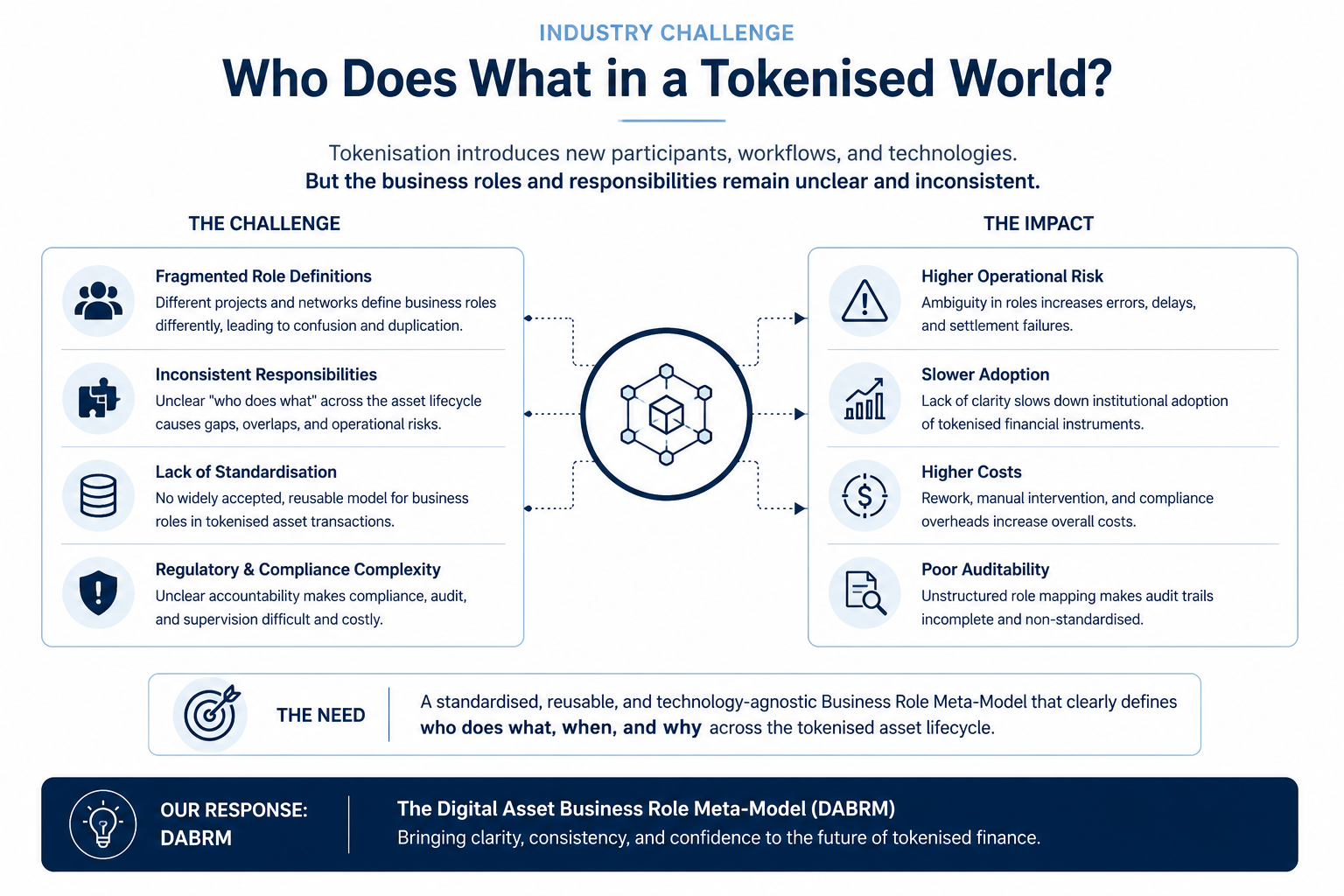
Tokenised assets, digital currencies, programmable finance and distributed financial infrastructures are introducing new actors, responsibilities, lifecycle events and business interactions. The challenge is not merely documenting these developments. It is deciding how financial standards should evolve without sacrificing reuse, consistency, interoperability or governance.

ISO 20022 provides a strong foundation for financial interoperability. Emerging digital-asset ecosystems, however, may introduce business semantics that are only partially represented—or not represented at all—within existing repository structures.

Standards engineers must therefore analyse each new requirement in relation to the complete repository, rather than treating it as an isolated modelling exercise.

This involves discovering reusable artefacts, interpreting semantic relationships, assessing downstream dependencies, distinguishing genuine gaps from terminology differences and preparing evidence for institutional review.

The process is knowledge-intensive and depends heavily on specialised expertise. As the range and complexity of digital financial use cases increase, purely manual exploration becomes difficult to scale consistently.

Repository Reuse

Does an existing business component, role or association already represent the requirement?

Semantic Novelty

Is the proposed concept genuinely new, or is it an alternative expression of existing business meaning?

Dependency Impact

Which existing artefacts, relationships and message structures may be affected by the proposed change?

Consistency

Will the proposed concept preserve established terminology, modelling principles and lifecycle integrity?

Explainability

Can reviewers independently understand the evidence and reasoning behind each engineering recommendation?

Governance

Can the repository evolve through controlled institutional review rather than automated or opaque modification?

Expanding Business Models New digital-asset actors, responsibilities and lifecycle interactions.
Complex Repository Knowledge Interconnected artefacts, dependencies, terminology and message definitions.
Evidence-Driven Decisions Reuse, extension or creation must be supported by transparent engineering evidence.
Institutional Accountability Human authorities must retain control over standards evolution.
Introducing DABRM

A Unified Platform for AI-Assisted Standards Engineering

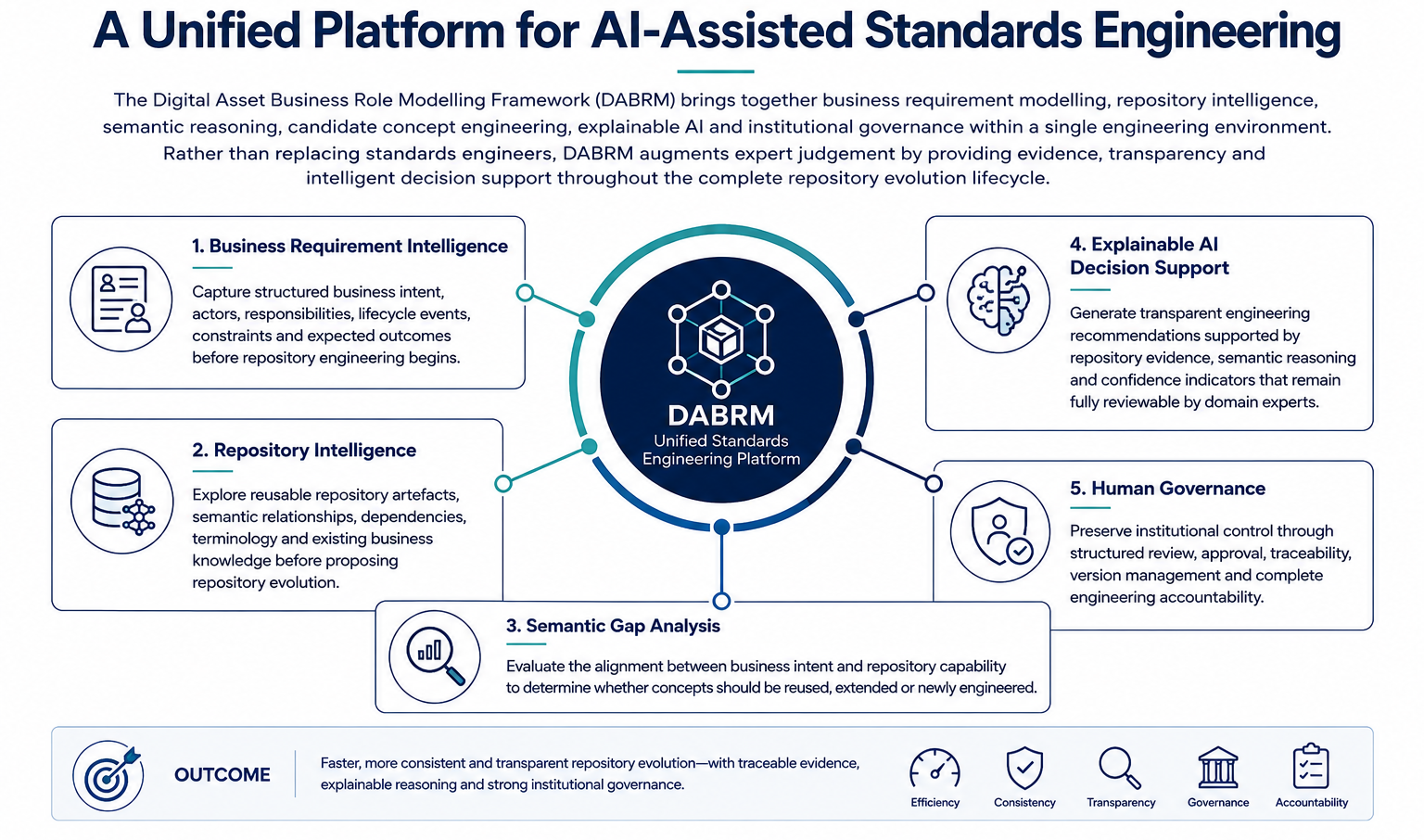
The Digital Asset Business Role Modelling Framework (DABRM) brings together business requirement modelling, repository intelligence, semantic reasoning, candidate concept engineering, explainable AI and institutional governance within a single engineering environment. Rather than replacing standards engineers, DABRM augments expert judgement by providing evidence, transparency and intelligent decision support throughout the complete repository evolution lifecycle.

Digital Asset Business Role Modelling Framework Solution Overview
Figure 2. The Digital Asset Business Role Modelling Framework integrates business analysis, repository intelligence, semantic reasoning, explainable AI and governance into a unified standards engineering platform.

Business Requirement Intelligence

Capture structured business intent, actors, responsibilities, lifecycle events, constraints and expected outcomes before repository engineering begins.

Repository Intelligence

Explore reusable repository artefacts, semantic relationships, dependencies, terminology and existing business knowledge before proposing repository evolution.

Semantic Gap Analysis

Evaluate the alignment between business intent and repository capability to determine whether concepts should be reused, extended or newly engineered.

Explainable AI Decision Support

Generate transparent engineering recommendations supported by repository evidence, semantic reasoning and confidence indicators that remain fully reviewable by domain experts.

Human Governance

Preserve institutional control through structured review, approval, traceability, version management and complete engineering accountability.

End-to-End Workflow

From Business Requirement to Governed Repository Evolution

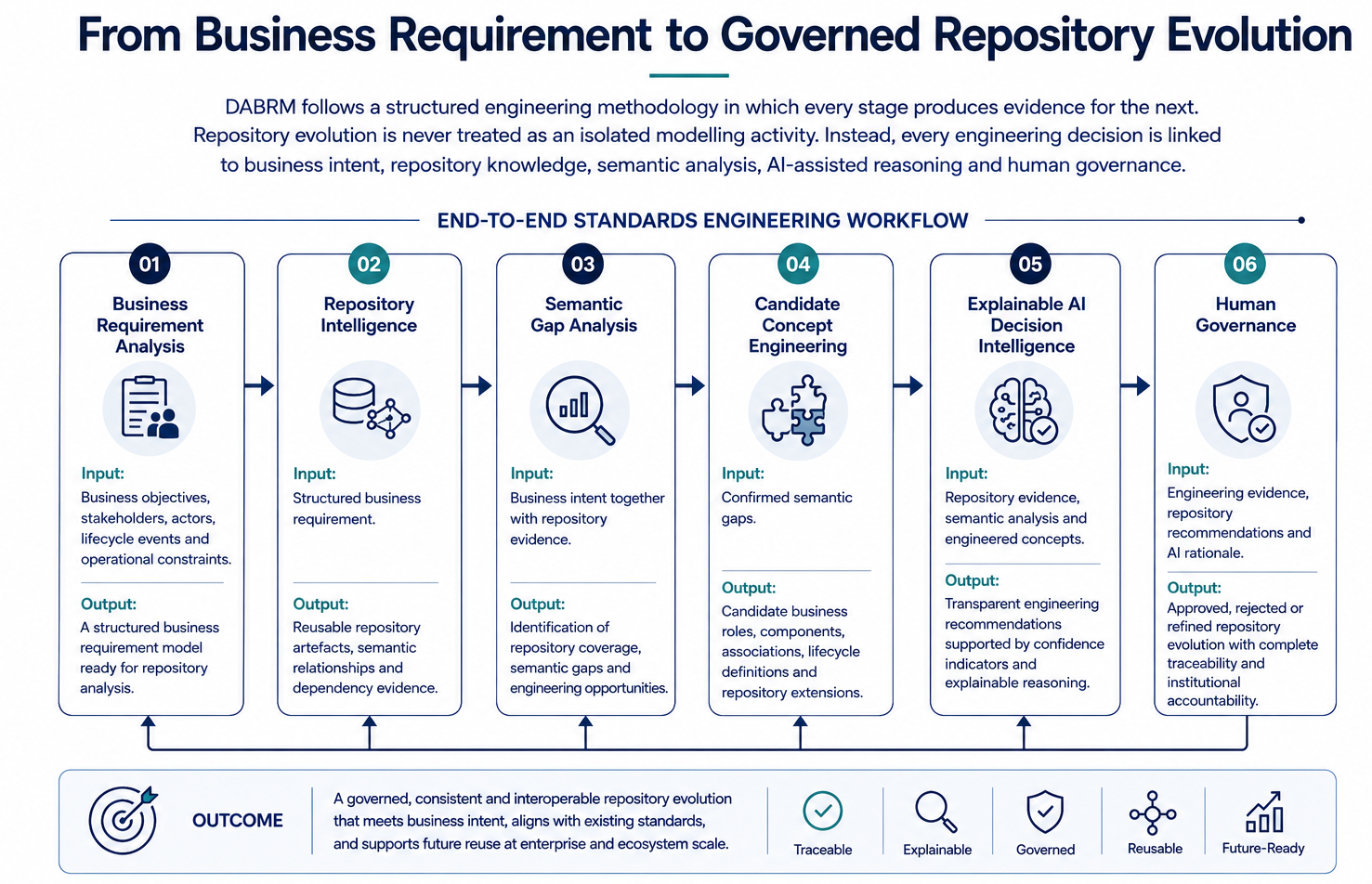
DABRM follows a structured engineering methodology in which every stage produces evidence for the next. Repository evolution is never treated as an isolated modelling activity. Instead, every engineering decision is linked to business intent, repository knowledge, semantic analysis, AI-assisted reasoning and human governance.

End-to-End Standards Engineering Workflow
Figure 3. End-to-end standards engineering workflow implemented within DABRM, illustrating the progression from business intent to governed repository evolution.

01. Business Requirement Analysis

Input: Business objectives, stakeholders, actors, lifecycle events and operational constraints.


Output: A structured business requirement model ready for repository analysis.

02. Repository Intelligence

Input: Structured business requirement.


Output: Reusable repository artefacts, semantic relationships and dependency evidence.

03. Semantic Gap Analysis

Input: Business intent together with repository evidence.


Output: Identification of repository coverage, semantic gaps and engineering opportunities.

04. Candidate Concept Engineering

Input: Confirmed semantic gaps.


Output: Candidate business roles, components, associations, lifecycle definitions and repository extensions.

05. Explainable AI Decision Intelligence

Input: Repository evidence, semantic analysis and engineered concepts.


Output: Transparent engineering recommendations supported by confidence indicators and explainable reasoning.

06. Human Governance

Input: Engineering evidence, repository recommendations and AI rationale.


Output: Approved, rejected or refined repository evolution with complete traceability and institutional accountability.

End-to-End Engineering Use Case

From an Emerging Business Requirement to Repository Evolution

The following example illustrates how DABRM supports a standards engineer throughout a complete engineering exercise. Rather than beginning with repository modelling, the process starts with business intent and progressively builds evidence that supports transparent engineering decisions and governed repository evolution.

Step 1

Capture Business Intent

A new business requirement describing a digital asset business interaction is submitted for standards engineering. The engineer records participating actors, responsibilities, operational objectives, lifecycle events and regulatory considerations.

Step 2

Explore Repository Knowledge

Repository Intelligence searches existing business roles, components, message concepts and semantic relationships to determine whether suitable artefacts already exist and identifies potential opportunities for reuse.

Step 3

Analyse Semantic Gaps

The business requirement is compared with existing repository knowledge to determine whether current repository structures fully satisfy the proposed business capability or whether meaningful semantic gaps remain.

Step 4

Engineer Candidate Concepts

Where repository gaps are confirmed, candidate business roles, business components, relationships and lifecycle definitions are engineered while maintaining consistency with existing repository modelling principles.

Step 5

AI-Assisted Evaluation

Explainable AI evaluates repository evidence and semantic analysis before producing engineering recommendations together with supporting rationale, confidence indicators and alternative approaches.

Step 6

Govern Repository Evolution

Engineering committees review repository evidence, AI recommendations and candidate concepts before approving, rejecting or refining repository evolution. Every decision becomes part of the permanent engineering record.

Platform Walkthrough

An Integrated Platform for End-to-End Standards Engineering

The Digital Asset Business Role Modelling Framework (DABRM) is organised as a sequence of integrated engineering workspaces that collectively support the complete standards engineering lifecycle. Rather than functioning as isolated tools, these workspaces continuously exchange structured engineering knowledge, allowing standards engineers to progress systematically from an emerging business requirement to governed repository evolution.

Each workspace performs a distinct engineering function while contributing to a unified workflow. Information produced by one workspace becomes validated engineering input for the next, ensuring complete traceability, semantic consistency, explainability and institutional governance throughout the standards development process.

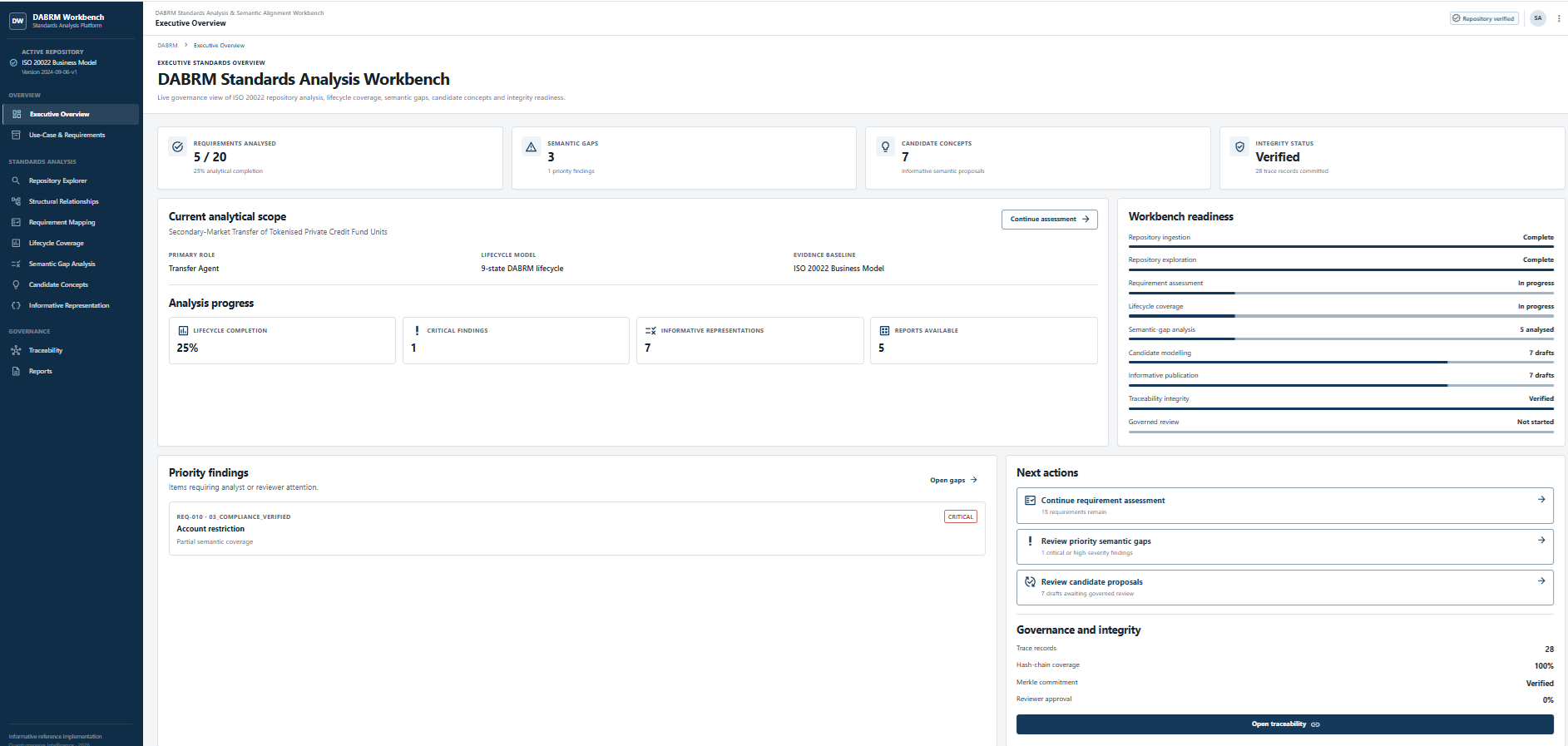
DABRM Platform Dashboard
Platform Dashboard. The Platform Dashboard provides a consolidated engineering view of active business requirements, repository exploration, semantic analysis, candidate concepts, AI-assisted recommendations and governance activities. It serves as the primary entry point into the DABRM platform and provides standards engineers with visibility across the complete repository engineering lifecycle.
Business Requirements Capture structured business intent, participating actors, lifecycle events, business rules and engineering context before repository analysis begins.
Repository Intelligence Discover reusable repository artefacts, semantic relationships, dependencies and existing business knowledge that may satisfy the proposed requirement.
Semantic Gap Analysis Compare business intent with repository knowledge to determine whether repository reuse, extension or new concept engineering is required.
Candidate Concept Engineering Develop candidate business roles, business components, relationships and repository extensions while maintaining modelling consistency.
AI Decision Intelligence Generate explainable engineering recommendations supported by repository evidence, semantic reasoning, confidence assessment and alternative modelling strategies.
Human Governance Enable expert review, approval, traceability, version management and governed repository evolution while ensuring that all engineering decisions remain under institutional control.

The following sections provide a detailed walkthrough of each engineering workspace, demonstrating how DABRM transforms an emerging business requirement into transparent, explainable and governed repository evolution.

Business Requirements Workspace

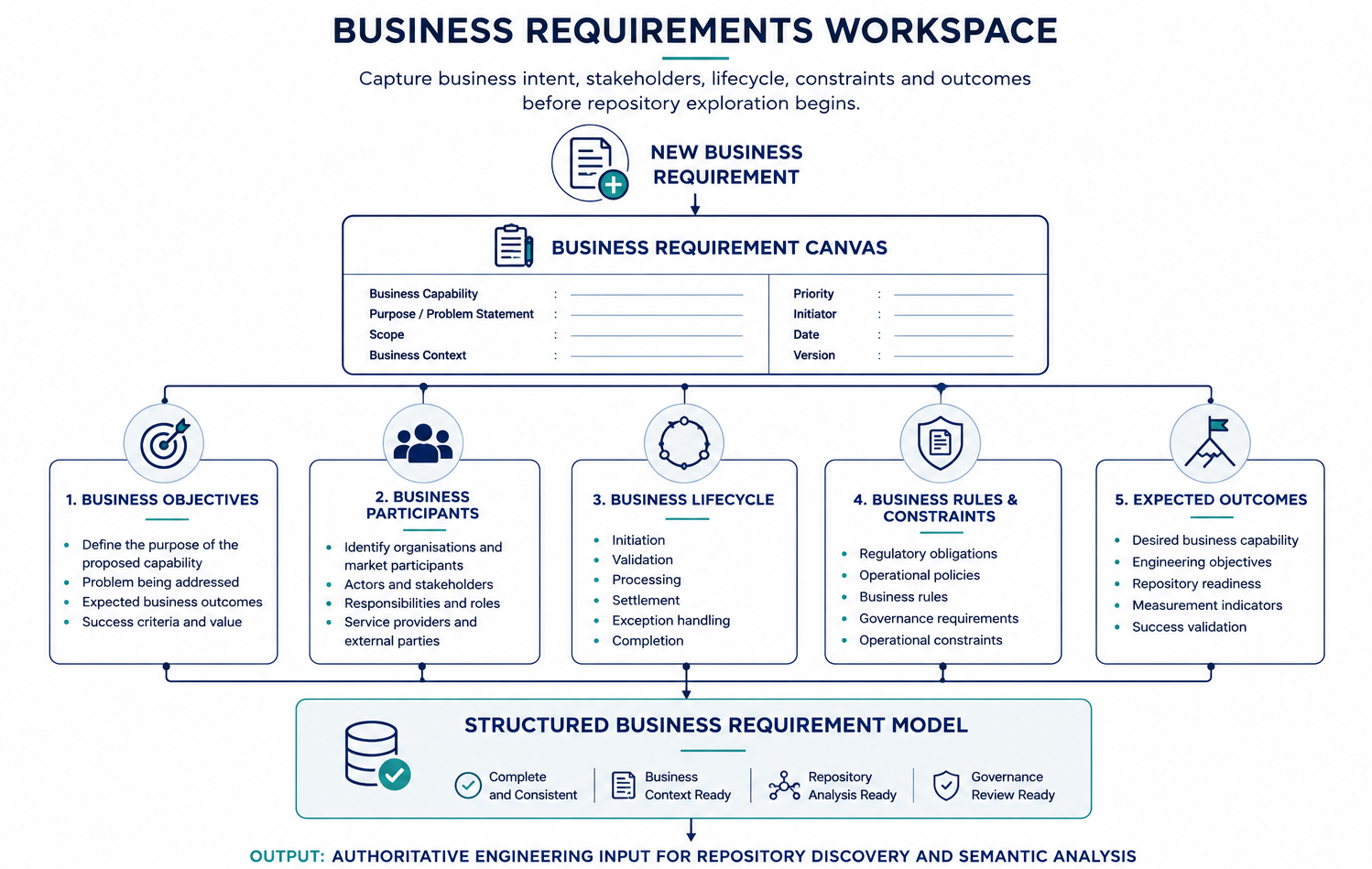
Every repository evolution initiative begins with a business requirement rather than a technical model. The Business Requirements Workspace provides a structured environment for capturing the business intent, participating stakeholders, operational context and engineering constraints that define the proposed capability. This information becomes the authoritative engineering input for all subsequent repository analysis.

Business Requirement Modelling
Figure 4. Structured business requirement modelling establishes the engineering context used throughout repository discovery, semantic analysis and governed repository evolution.


Business Requirements Workspace. Standards engineers capture business objectives, participating actors, lifecycle events, operational constraints and expected outcomes in a structured form before repository exploration begins.

Business Objectives

Define the purpose of the proposed business capability, the problem being addressed and the expected business outcomes.

Business Participants

Identify the organisations, market participants, service providers and other stakeholders involved in the business interaction together with their respective responsibilities.

Business Lifecycle

Describe the complete lifecycle of the business interaction, including initiation, processing, settlement, exception handling and completion.

Business Rules and Constraints

Record regulatory obligations, operational policies, governance requirements and business constraints that influence repository engineering.

Structured Engineering Output

Produce a structured business model that serves as the engineering input for repository discovery, semantic comparison, AI-assisted analysis and governance review.

Once the business requirement has been formalised, DABRM automatically progresses to the Repository Intelligence Workspace, where the proposed capability is analysed against existing repository knowledge to maximise reuse before new concepts are considered.

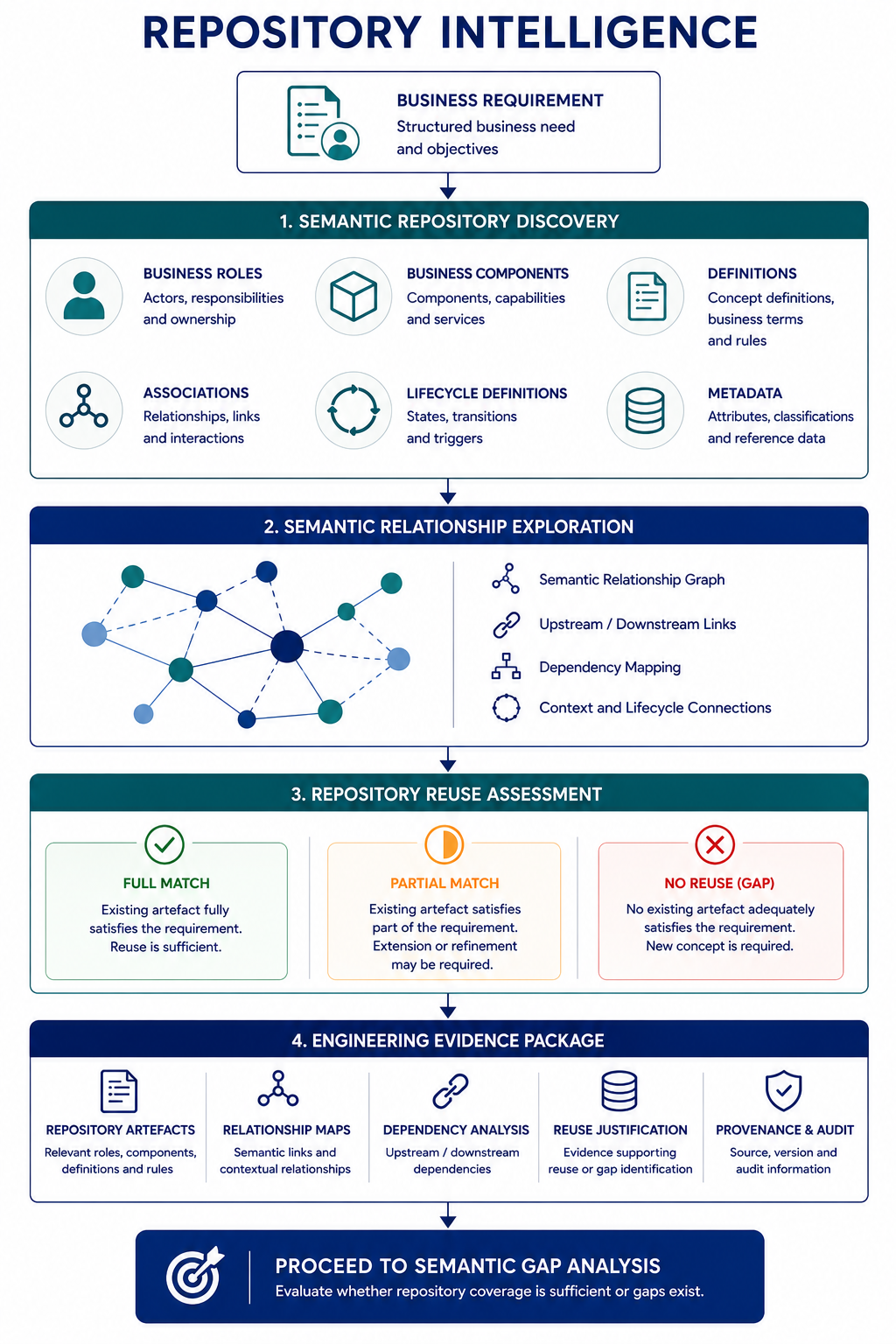
Repository Intelligence Workspace

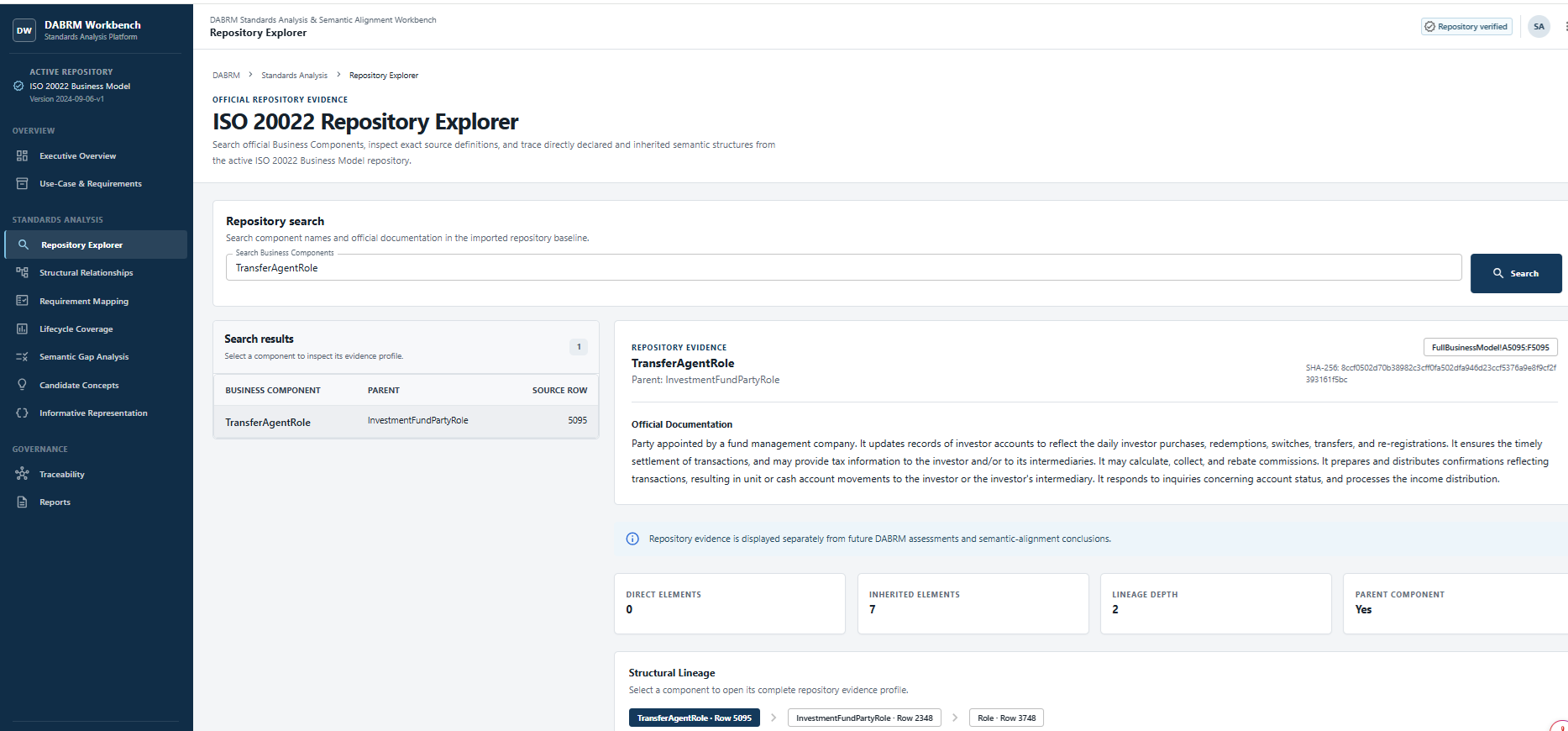
Once a business requirement has been captured, the next step is to determine whether the existing repository already contains concepts that satisfy the proposed capability. The Repository Intelligence Workspace enables standards engineers to explore repository knowledge using semantic understanding rather than simple keyword searches. By analysing reusable artefacts, dependencies and relationships, DABRM promotes repository reuse, reduces unnecessary duplication and preserves semantic consistency across the standards ecosystem.

Repository Intelligence
Figure 5. Repository Intelligence explores existing business components, business roles, relationships and reusable engineering knowledge to identify opportunities for repository reuse before introducing new concepts.


Repository Intelligence Workspace
Repository Intelligence Workspace. The workspace enables standards engineers to perform semantic repository searches, analyse dependencies, explore relationships and collect engineering evidence supporting repository evolution decisions.

Semantic Repository Discovery

Locate business components, business roles, associations, definitions and metadata using contextual meaning rather than simple keyword matching.

Relationship Exploration

Visualise semantic relationships between repository artefacts to understand how business concepts interact across the complete repository model.

Repository Reuse Assessment

Evaluate whether existing repository artefacts fully or partially satisfy the proposed business requirement before considering repository extension.

Dependency Analysis

Identify downstream business components, message definitions and related repository artefacts that may be affected by future repository evolution.

Engineering Evidence Collection

Assemble repository evidence that supports semantic gap analysis, explainable AI recommendations and governance review throughout the engineering lifecycle.

Repository Intelligence establishes what already exists within the standards repository. DABRM then proceeds to the Semantic Gap Analysis Workspace, where the proposed business requirement is systematically compared against repository knowledge to determine whether repository reuse is sufficient or whether controlled repository evolution is justified.

Semantic Gap Analysis Workspace

Repository Intelligence identifies existing repository artefacts that appear relevant to a proposed business requirement. However, discovering similar concepts does not necessarily mean that the repository already supports the required business capability. Different business concepts may use similar terminology while representing entirely different responsibilities, behaviours or relationships. Determining whether existing repository knowledge is truly sufficient requires a deeper semantic assessment.

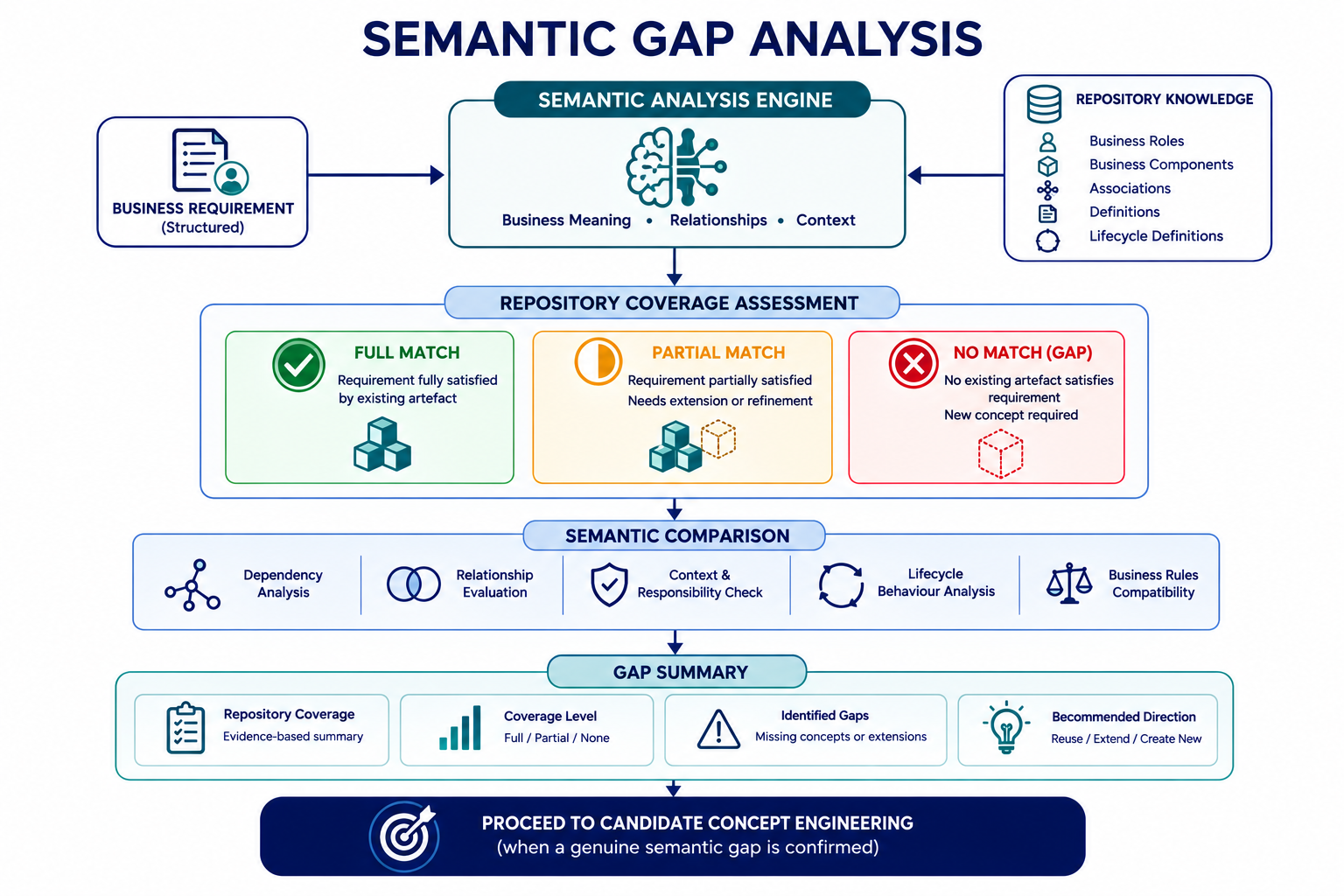
The Semantic Gap Analysis Workspace performs this assessment by comparing the structured business requirement with repository knowledge at the level of business meaning rather than textual similarity. Its objective is to determine whether the proposed capability can be satisfied through repository reuse, whether an existing concept should be extended, or whether a genuinely new repository concept is required. Repository evolution is therefore driven by engineering evidence rather than subjective judgement.

Semantic Gap Analysis
Figure 6. Semantic Gap Analysis evaluates business meaning, repository coverage and semantic relationships to determine whether repository reuse is sufficient or controlled repository evolution is justified.


Semantic Gap Analysis Workspace
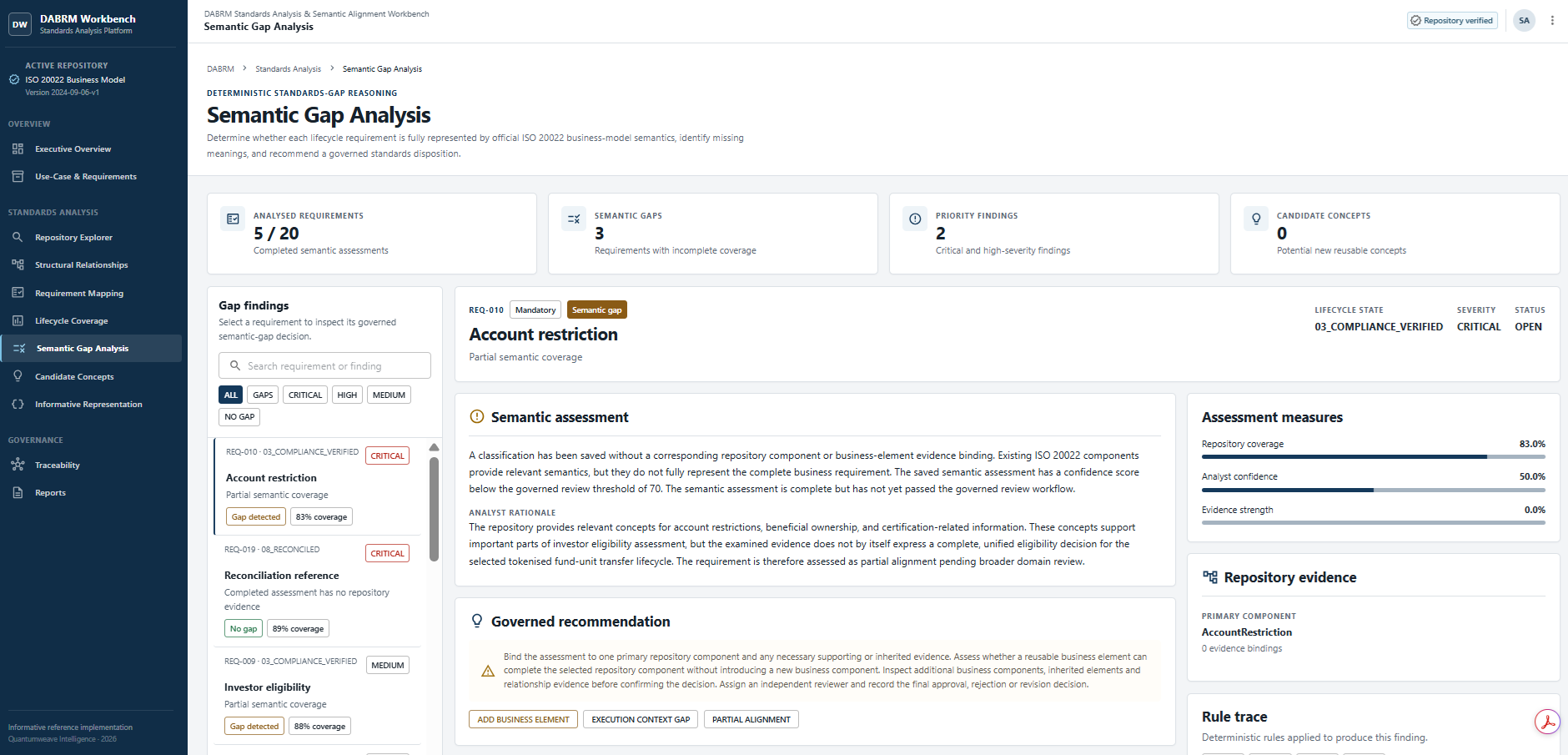
Semantic Gap Analysis Workspace. Standards engineers review repository coverage, semantic similarity, identified gaps, supporting repository evidence and engineering recommendations before deciding whether repository evolution should be considered.

What Happens in this Workspace?

The structured business requirement is compared against existing repository artefacts using semantic reasoning, business relationships and modelling context to determine whether the repository already supports the proposed capability.

Why is this Analysis Necessary?

Repository searches often identify concepts that appear similar but differ in responsibilities, lifecycle behaviour or business relationships. Semantic Gap Analysis distinguishes genuine reuse opportunities from concepts that only appear similar, preventing both unnecessary repository growth and inappropriate reuse.

Repository Coverage Assessment

Every relevant repository artefact is assessed to determine whether it fully satisfies, partially satisfies or does not satisfy the proposed business requirement, together with supporting engineering evidence.

Engineering Example

Suppose Repository Intelligence identifies the existing repository roles Custodian and Account Servicer while analysing a new digital asset settlement process. Although these roles appear similar, Semantic Gap Analysis determines that neither adequately represents custody responsibilities associated with programmable digital assets. The analysis therefore concludes that repository reuse is insufficient and recommends engineering a candidate Digital Asset Custodian concept rather than reusing an inappropriate existing role.

Engineering Outcome

The workspace produces structured engineering evidence describing repository coverage, identified semantic gaps, supporting rationale and proposed engineering direction. This evidence becomes the foundation for Candidate Concept Engineering and subsequent governance review.

Once a genuine semantic gap has been confirmed, DABRM proceeds to the Candidate Concept Engineering Workspace, where standards engineers develop candidate repository artefacts that address the identified capability while preserving repository consistency and established modelling principles.

Candidate Concept Engineering Workspace

Once Semantic Gap Analysis confirms that the existing repository cannot adequately represent a proposed business capability, the next step is to design an appropriate repository extension. Rather than modifying the repository directly, DABRM provides a dedicated engineering workspace where standards engineers can systematically develop, validate and refine candidate repository concepts before they are submitted for institutional review.

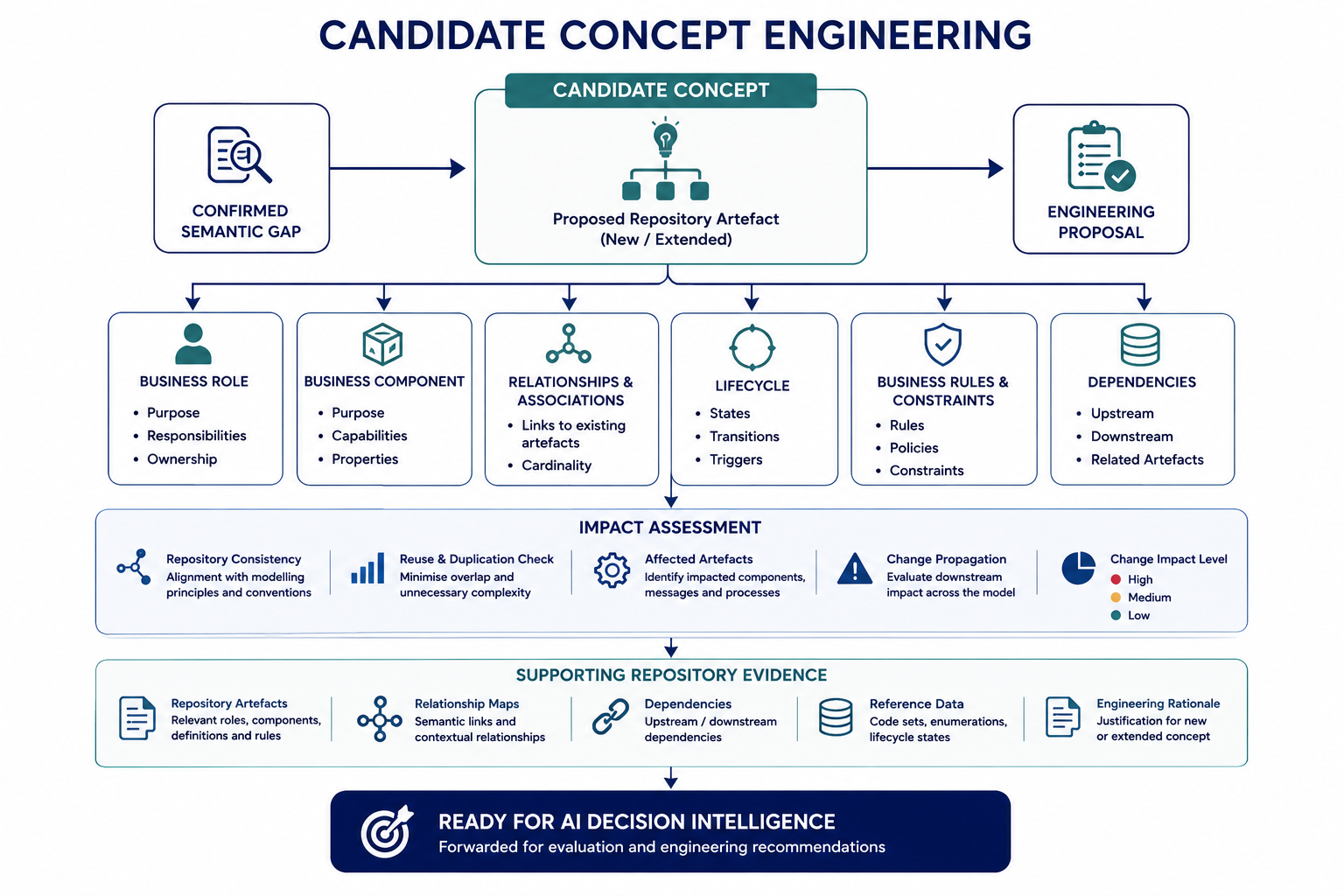
A candidate concept is a proposed repository artefact that may introduce a new business role, business component, relationship, lifecycle definition or business rule. Every proposal is engineered using established repository modelling principles and supported by repository evidence collected during the previous analysis stages. This ensures that repository evolution remains consistent, explainable and aligned with existing standards.

Candidate Concept Engineering
Figure 7. Candidate repository concepts are engineered using semantic evidence, repository knowledge and existing modelling principles before governance review.


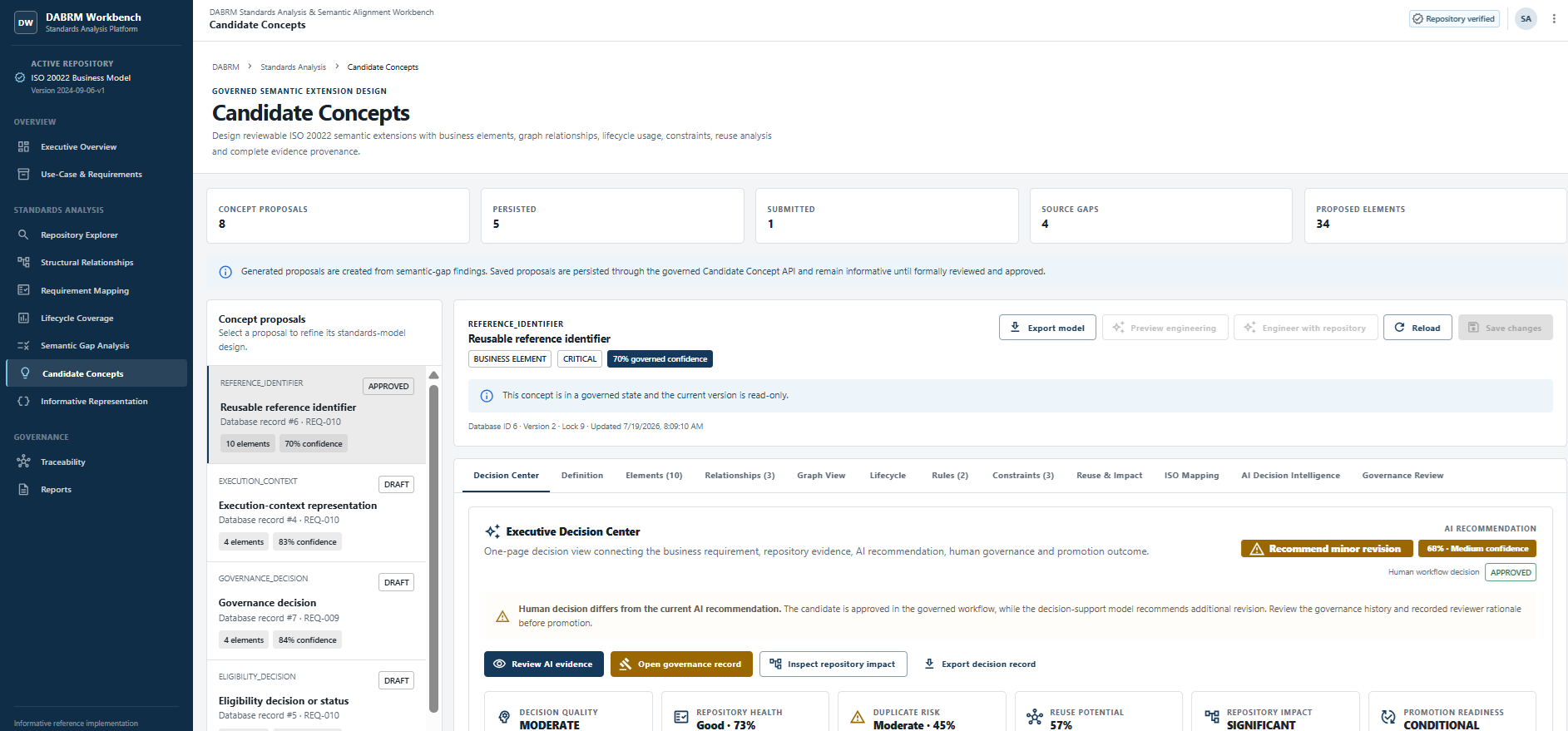
Candidate Concept Engineering Workspace
Candidate Concept Engineering Workspace. Engineers create candidate repository concepts, establish relationships with existing artefacts, evaluate repository impact and prepare proposals for engineering review.

What Happens in this Workspace?

Confirmed semantic gaps are transformed into structured engineering proposals. Engineers define candidate repository artefacts together with their purpose, responsibilities, relationships, lifecycle behaviour and business constraints.

Why is Candidate Engineering Required?

Repository evolution should never occur by simply adding new concepts. Every proposed artefact must be designed to integrate naturally with existing repository structures while minimising unnecessary complexity and duplication.

Engineering Activities

Engineers model candidate business roles, business components, semantic relationships, ownership, lifecycle definitions, business rules and repository dependencies while evaluating the broader impact on repository consistency.

Engineering Example

Continuing the previous example, Semantic Gap Analysis concluded that neither Custodian nor Account Servicer adequately represents custody responsibilities for programmable digital assets. Engineers therefore create a candidate Digital Asset Custodian concept, define its business responsibilities, identify its relationships with existing settlement participants and assess whether existing message definitions or business processes require corresponding repository updates.

Engineering Outcome

The completed proposal contains candidate repository artefacts, supporting repository evidence, engineering rationale, dependency analysis and impact assessment. Rather than immediately approving the proposal, DABRM forwards it to the Explainable AI Decision Intelligence Workspace for additional evaluation and engineering recommendations.

Repository engineering frequently presents multiple valid modelling alternatives. The next workspace, Explainable AI Decision Intelligence, analyses the candidate proposal together with repository knowledge to generate transparent engineering recommendations supported by semantic evidence and confidence assessment, enabling standards engineers to make well-informed decisions.

Explainable AI Decision Intelligence

Engineering repository evolution rarely results in a single obvious solution. Multiple repository modelling strategies may satisfy the same business requirement, each with different implications for repository consistency, interoperability and future extensibility. Selecting the most appropriate approach therefore requires careful evaluation of repository knowledge, semantic relationships, historical modelling decisions and engineering constraints.

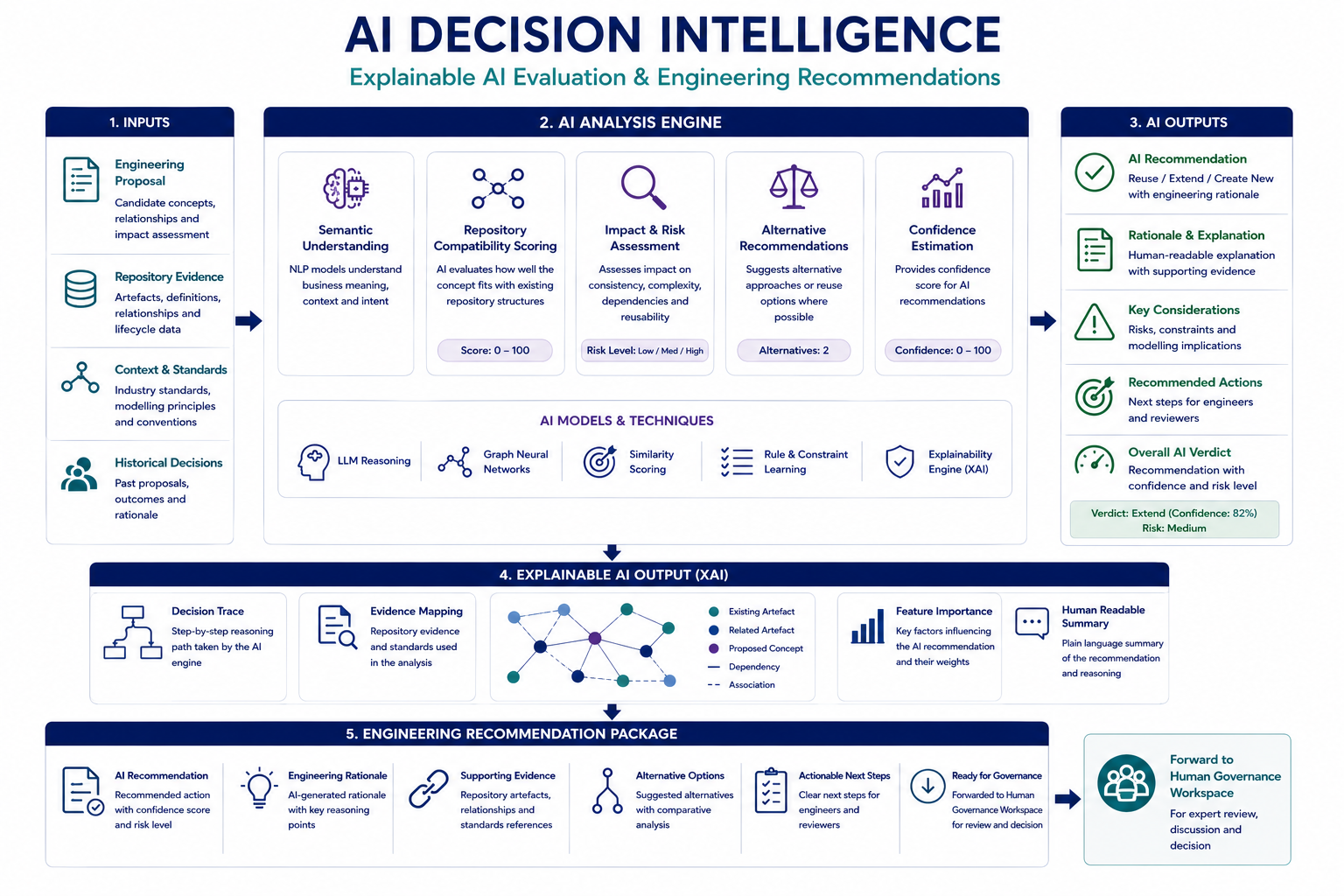
The Explainable AI Decision Intelligence Workspace assists standards engineers by analysing repository evidence and generating transparent engineering recommendations. Rather than replacing human expertise, AI functions as an engineering assistant that explains why particular repository evolution strategies may be appropriate. Every recommendation is fully supported by repository evidence, semantic reasoning and confidence assessment, allowing engineers to independently validate, challenge or reject the proposed approach.

Explainable AI Decision Intelligence
Figure 8. Explainable AI analyses repository evidence, semantic relationships and engineering constraints to generate transparent recommendations supporting repository evolution.


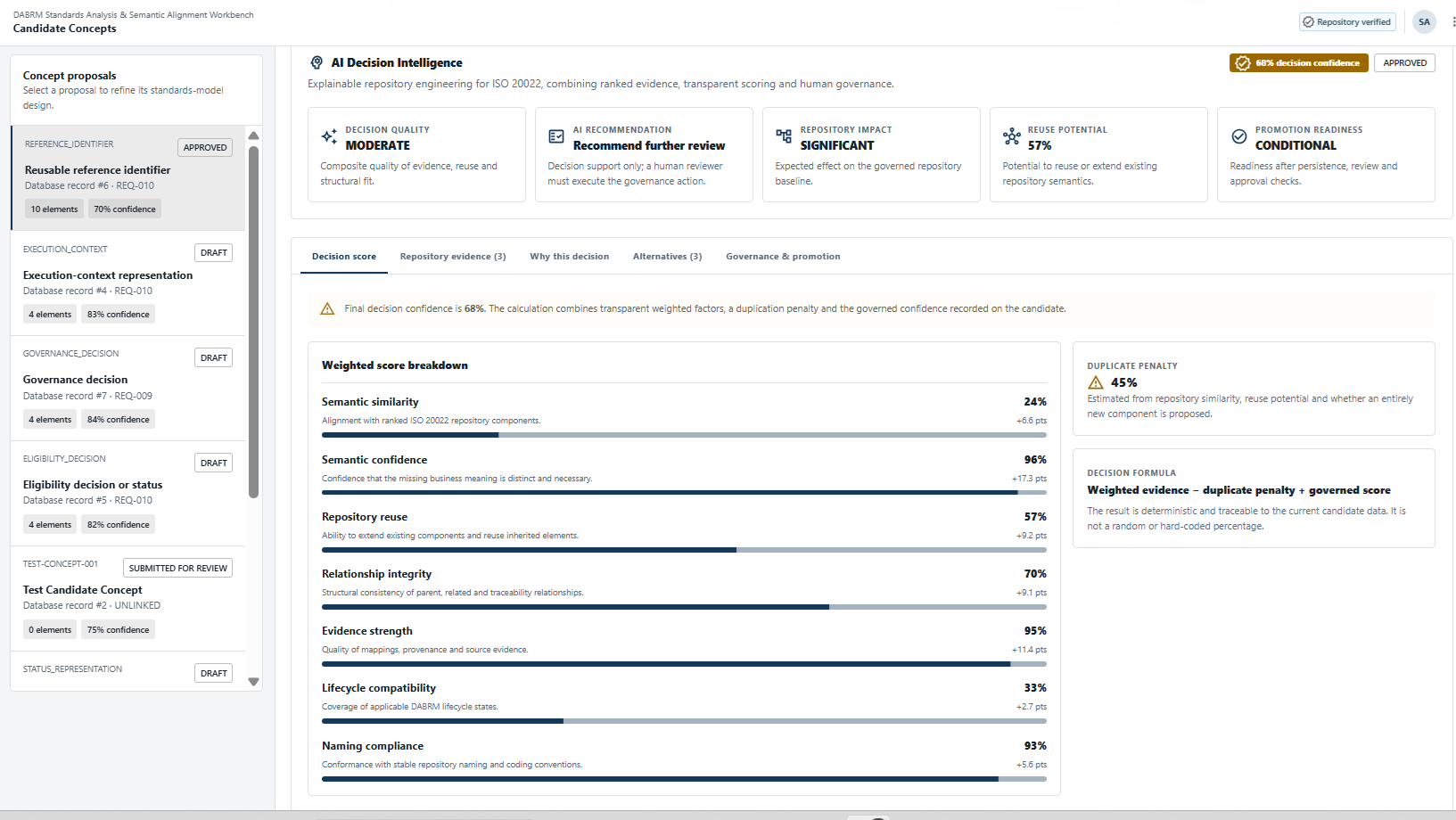
AI Decision Intelligence Workspace
Explainable AI Decision Intelligence Workspace. Repository evidence, semantic reasoning, confidence scores, engineering alternatives and supporting rationale are presented together, enabling standards engineers to evaluate every recommendation before governance review.

What Happens in this Workspace?

AI analyses the candidate repository proposal together with repository knowledge collected during the previous engineering stages. It evaluates semantic similarity, repository consistency, engineering constraints and historical repository patterns before producing explainable recommendations.

Why is AI Required?

Repository evolution often involves multiple valid engineering alternatives. AI rapidly evaluates these alternatives using repository evidence, helping standards engineers understand the advantages, limitations and potential impact of each approach while leaving the final engineering decision entirely under human control.

Engineering Example

Continuing the previous example, AI evaluates the proposed Digital Asset Custodian concept against existing repository roles such as Custodian, Account Servicer and Settlement Agent. Rather than recommending a single answer, the workspace may present several engineering alternatives—for example extending an existing role, introducing a specialised Digital Asset Custodian or creating an entirely new repository component. Each option is accompanied by repository evidence, semantic justification and confidence assessment.

Explainable Recommendations

Every recommendation includes supporting repository artefacts, semantic relationships, confidence scores and engineering rationale. Standards engineers can inspect the evidence behind each recommendation rather than accepting AI output as an opaque decision.

Engineering Outcome

The workspace produces an evidence-based engineering recommendation that supports, but never replaces, expert judgement. The complete engineering package is then submitted to the Human Governance Workspace, where authorised reviewers evaluate, modify or reject the proposal before repository evolution is approved.

AI recommendations are advisory rather than authoritative. Repository evolution remains an institutional responsibility. The final engineering decision is therefore made within the Human Governance Workspace, where experts review repository evidence, candidate concepts, AI recommendations and engineering impact before approving any repository modification.

Human Governance Workspace

Repository evolution ultimately remains the responsibility of authorised standards engineers and governance committees. Although DABRM provides repository intelligence, semantic analysis and AI-assisted engineering recommendations, no repository modification is performed automatically. Every proposed repository change undergoes formal human review before it can become part of the standards repository.

The Human Governance Workspace consolidates the complete engineering evidence generated throughout the previous workspaces. Reviewers can examine the original business requirement, repository analysis, semantic gap assessment, candidate repository concepts, AI recommendations and impact analysis before making an informed engineering decision. This ensures that repository evolution remains transparent, accountable and aligned with institutional governance principles.

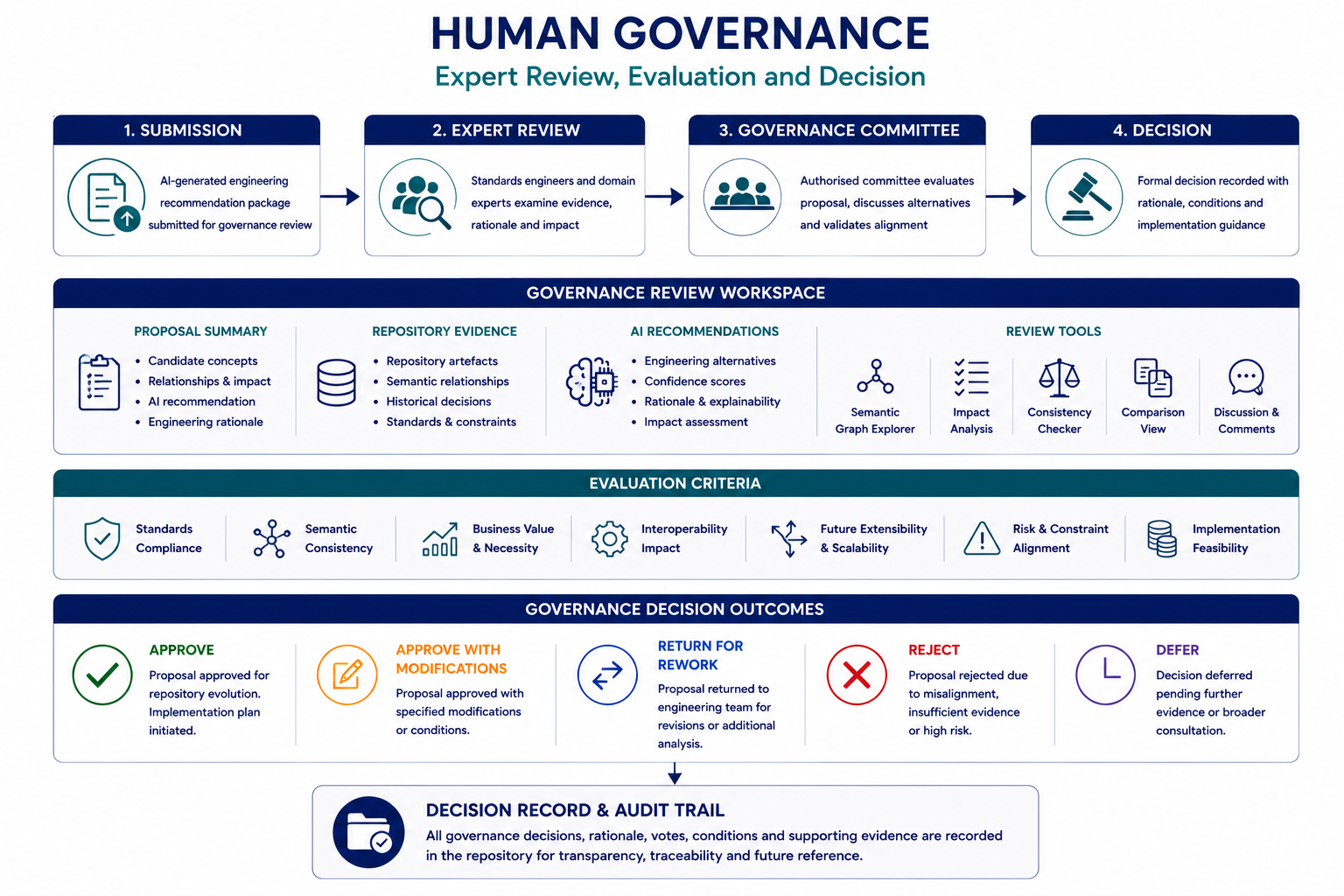
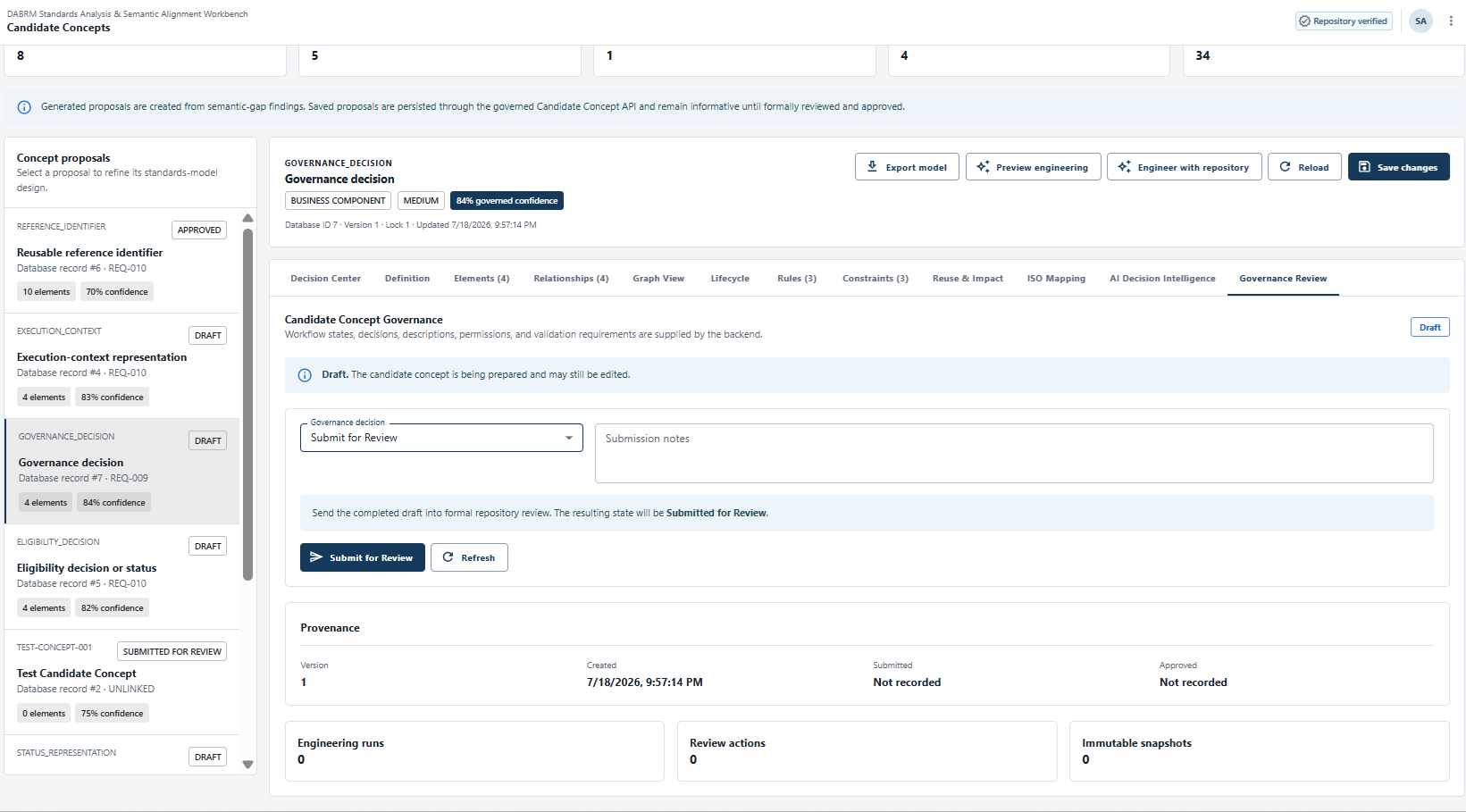
Human Governance
Figure 9. Human Governance consolidates engineering evidence, repository analysis and AI recommendations into a transparent review process where authorised experts evaluate every proposed repository evolution.


Human Governance Workspace
Human Governance Workspace. Standards engineers review candidate repository concepts, repository evidence, AI recommendations, engineering rationale and repository impact before approving, revising or rejecting repository evolution proposals.

What Happens in this Workspace?

All engineering artefacts produced during the previous workspaces are brought together into a single governance environment. Reviewers evaluate repository evidence, engineering rationale and AI-supported recommendations before making the final repository decision.

Why is Human Governance Required?

Repository evolution influences future standards, interoperability and industry adoption. Such decisions require engineering expertise, institutional oversight and organisational accountability. Human Governance ensures that repository modifications remain controlled, transparent and fully explainable.

Engineering Example

Continuing the previous example, reviewers examine the proposed Digital Asset Custodian concept together with the original business requirement, repository search results, semantic gap analysis, candidate concept model, AI recommendations and repository impact assessment. After reviewing the supporting evidence, the governance committee may approve the proposal, request refinements or conclude that an existing repository concept should instead be extended.

Governance Activities

Reviewers can compare proposal versions, record engineering observations, assign review actions, collaborate with other experts and formally approve or reject repository evolution proposals while preserving complete engineering accountability.

Engineering Outcome

Every governance decision is accompanied by documented engineering rationale and supporting evidence. Approved concepts become eligible for repository publication, while rejected or revised proposals retain their full engineering history for future reference.

Once governance decisions have been completed, DABRM records the complete engineering history of the proposal. Every business requirement, repository analysis, engineering decision, reviewer comment and approval becomes part of a permanent engineering record maintained through the Engineering Traceability Framework.

Engineering Traceability & Decision History

Repository evolution is not limited to introducing new concepts. Every engineering decision must remain transparent, reproducible and understandable long after the repository has evolved. Standards engineers should be able to determine not only what changed, but also why it changed, what engineering evidence supported the decision and who authorised the final repository evolution.

DABRM automatically records the complete engineering lifecycle of every repository proposal. From the original business requirement through repository exploration, semantic analysis, candidate concept engineering, AI-assisted recommendations and governance review, every engineering artefact is linked together to create a permanent and auditable chain of engineering evidence.

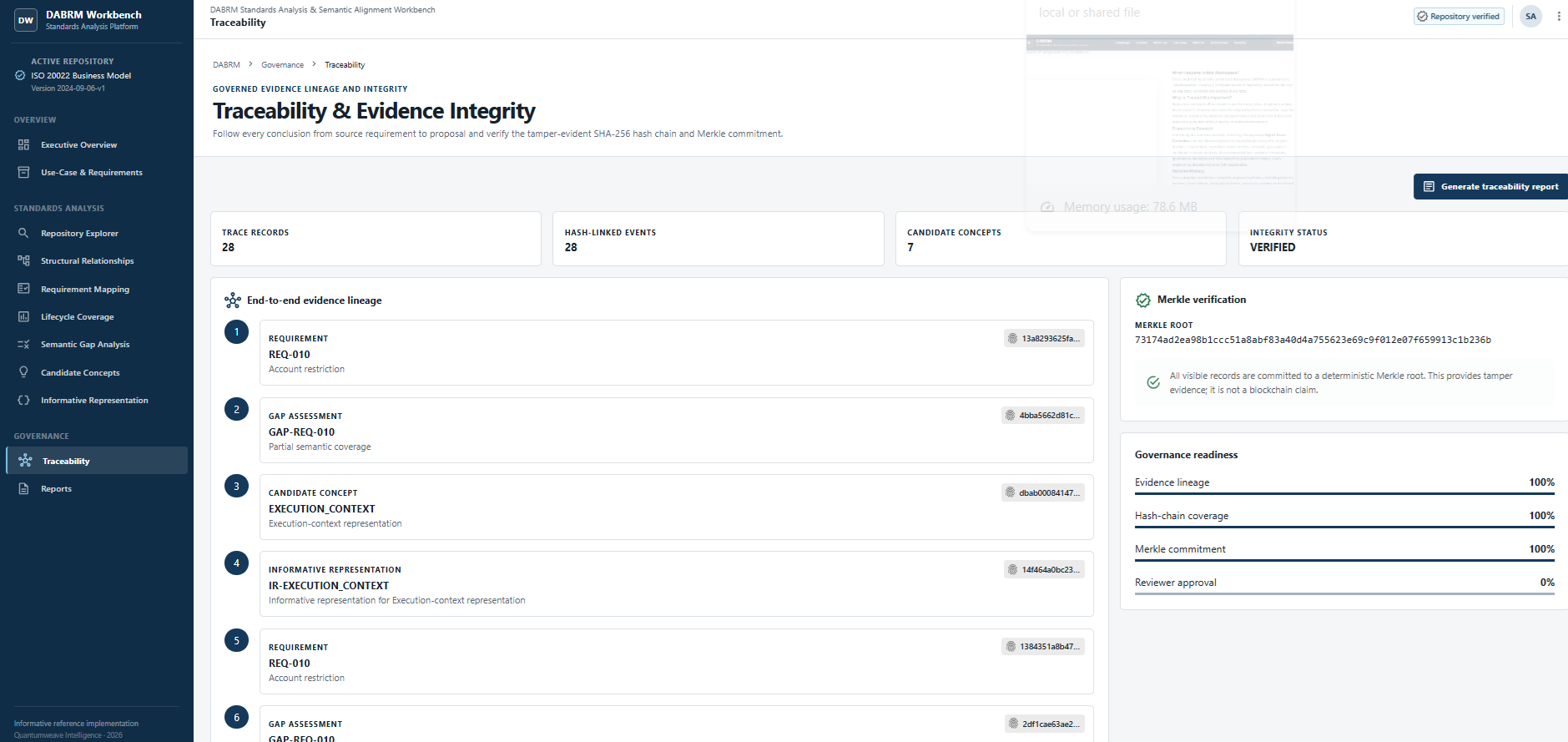
Engineering Traceability
Figure 10. Engineering Traceability links every stage of repository evolution, enabling standards engineers to understand how business requirements, repository evidence, engineering decisions and governance approvals are connected throughout the complete engineering lifecycle.

What Happens in this Workspace?

Every engineering activity performed throughout DABRM is automatically linked together, creating a complete record of repository evolution that can be explored, reviewed and audited at any time.

Why is Traceability Important?

Repository concepts often remain in use for many years. Engineers joining future projects should understand the original business motivation, repository evidence, engineering rationale and governance decisions that led to each repository evolution without relying on institutional memory.

Engineering Example

Continuing the previous example, selecting the approved Digital Asset Custodian concept allows engineers to immediately access the original business requirement, repository search results, semantic gap analysis, candidate concept versions, AI recommendations, reviewer comments, governance decisions and final repository publication history. Every engineering decision remains fully explainable.

Decision History

Every proposal maintains a complete engineering history including revisions, reviewer observations, approval decisions, repository updates and supporting evidence, ensuring that repository evolution remains transparent throughout its lifecycle.

Engineering Outcome

DABRM establishes complete engineering provenance for every repository artefact, enabling standards organisations to confidently understand how repository evolution occurred, who approved it and which engineering evidence supported every decision.

Together, the integrated engineering workspaces transform repository evolution into a structured, evidence-driven and governed engineering process. The following section presents the overall platform architecture, illustrating how these capabilities are implemented as a modular engineering platform.

Platform Architecture

DABRM is designed as an integrated engineering platform rather than a collection of independent software modules. Every workspace contributes to a continuous engineering lifecycle, allowing business requirements to progress systematically from initial capture through repository analysis, semantic evaluation, concept engineering, AI-assisted decision support, governance review and engineering traceability. Each stage builds upon the evidence produced by the previous stage, creating a transparent and well-governed repository evolution process.

The platform combines human expertise with explainable AI while maintaining clear separation between engineering assistance and engineering authority. Artificial Intelligence accelerates analysis, identifies engineering alternatives and provides evidence-based recommendations, whereas repository evolution remains under the control of authorised standards engineers and governance committees. This architecture enables innovation without compromising institutional oversight, consistency or accountability.

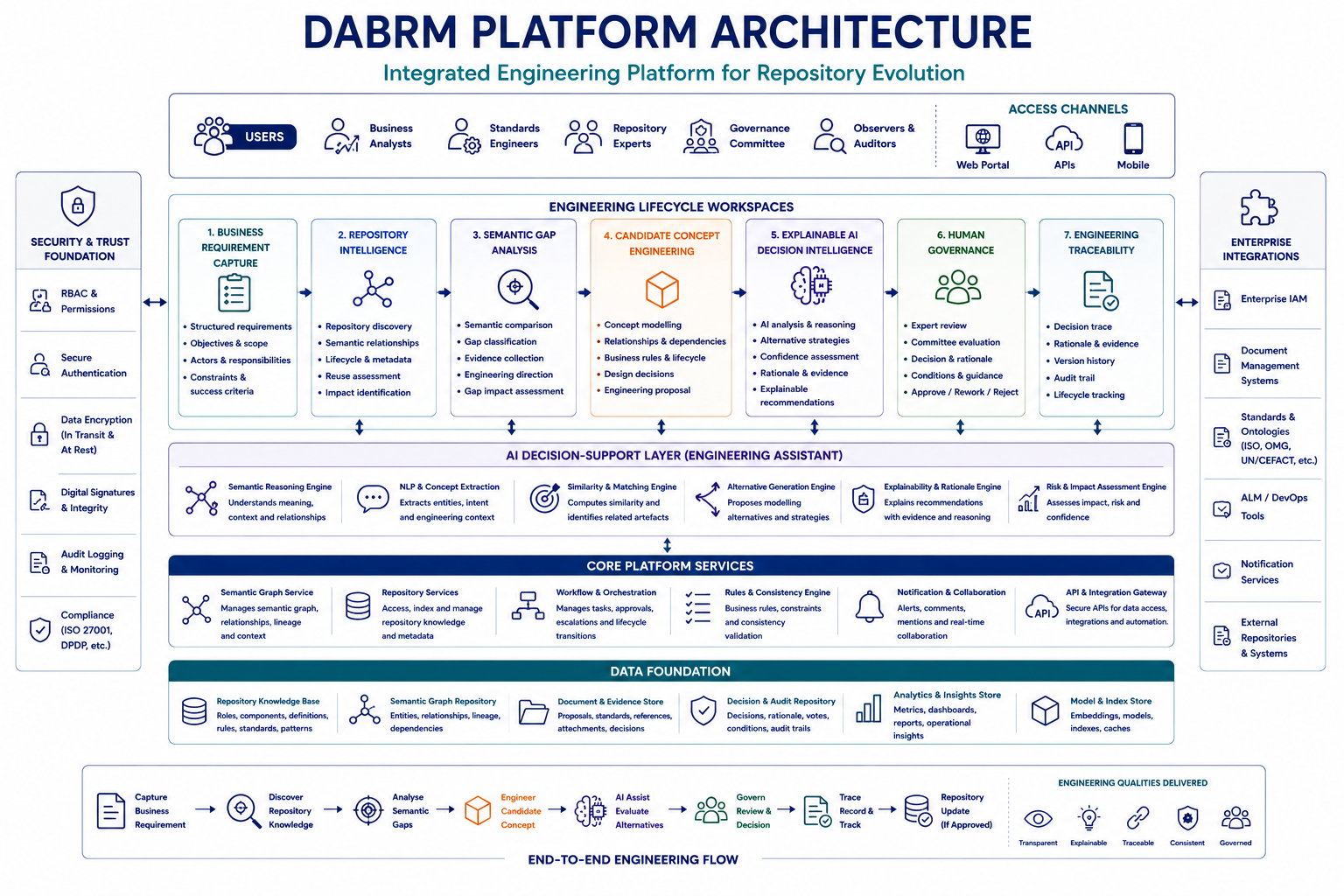
DABRM Platform Architecture
Figure 11. The DABRM platform integrates business requirement capture, repository intelligence, semantic reasoning, candidate concept engineering, explainable AI, governance and engineering traceability into a unified repository engineering ecosystem.

What Does the Platform Do?

The platform manages the complete lifecycle of repository evolution. Beginning with a business requirement, it guides engineers through repository discovery, semantic assessment, engineering design, AI-supported evaluation, governance review and traceability, ensuring that every repository change is supported by engineering evidence.

How Does Information Flow?

Information progresses sequentially across the engineering workspaces. Business requirements become structured engineering artefacts, repository knowledge is analysed for reuse opportunities, semantic gaps are identified, candidate concepts are engineered, AI evaluates modelling alternatives and governance validates the final proposal before repository updates are approved. Engineering evidence accompanies the proposal throughout the entire lifecycle.

Where Does Artificial Intelligence Fit?

AI is embedded as an engineering decision-support layer rather than as an autonomous decision-maker. It assists engineers by analysing repository knowledge, identifying semantic relationships, evaluating alternative modelling strategies and explaining the reasoning behind every recommendation. Human reviewers remain responsible for all repository decisions.

Why is Governance Embedded Throughout?

Governance is not treated as a final approval step. Engineering evidence, reviewer observations, explainable AI recommendations and traceability records are continuously accumulated throughout the lifecycle. This ensures that governance decisions are based on a complete engineering context rather than isolated documents or individual opinions.

End-to-End Example

Consider the introduction of the Digital Asset Custodian role. The platform captures the new business requirement, searches the repository for similar concepts, determines that no existing role fully satisfies the requirement, engineers a candidate concept, evaluates alternative modelling strategies using explainable AI, supports governance review with complete engineering evidence and permanently records the approved decision for future repository maintenance. Every engineering activity remains connected within a single, traceable workflow.

By integrating repository intelligence, semantic engineering, explainable AI, governance and traceability into a unified platform, DABRM transforms repository evolution from a document-centric activity into a structured, evidence-driven engineering process. The following section summarises the practical benefits this approach delivers to standards organisations, repository engineers and the wider financial ecosystem.

Engineering Value for Standards Organisations

Repository evolution involves balancing innovation with stability. Standards organisations must respond to emerging business requirements while preserving repository consistency, interoperability and governance. DABRM supports this objective by providing an integrated engineering environment where repository evolution is guided by structured analysis, explainable AI and human expertise rather than isolated documents or disconnected review activities.

The value of the platform extends beyond engineering productivity. By connecting every stage of repository evolution—from business requirement capture to governance and traceability—DABRM helps standards organisations improve engineering quality, strengthen institutional knowledge and maintain confidence in repository evolution decisions.

For Standards Engineers

Engineers work within a structured engineering workflow that combines repository exploration, semantic analysis, candidate concept modelling, AI-assisted evaluation and governance support. This reduces time spent on repetitive repository analysis while allowing engineers to focus on high-value modelling decisions.

For Repository Governance

Governance decisions are supported by complete engineering evidence rather than individual interpretations. Reviewers can examine business requirements, repository analysis, semantic reasoning, candidate concepts, AI recommendations and engineering history before approving repository evolution.

For Enterprise Architects

Repository evolution follows a consistent engineering methodology that promotes reuse before extension, encourages semantic consistency and helps minimise unnecessary repository complexity as standards continue to evolve.

For Artificial Intelligence Adoption

AI operates as an explainable engineering assistant rather than an autonomous decision-maker. Recommendations are accompanied by supporting repository evidence, semantic reasoning and confidence assessment, enabling engineers to understand and validate every recommendation.

For Organisational Knowledge

Engineering decisions remain available long after projects have concluded. Future engineers can understand why repository concepts were introduced, what alternatives were considered and how governance decisions were reached, reducing dependence on institutional memory.

For the Financial Ecosystem

Well-governed repository evolution contributes to more consistent business models, improved interoperability and greater confidence in future standards development across financial institutions, technology providers and industry participants.

Throughout this walkthrough, the example of introducing a Digital Asset Custodian role has illustrated how DABRM transforms an initial business requirement into a fully governed repository evolution process. The following demonstration provides a practical walkthrough of the platform and shows how these engineering workspaces operate together in a real engineering environment.

Platform Demonstration

The preceding sections described how DABRM supports repository evolution through structured engineering, semantic reasoning, explainable AI and governed decision-making. The demonstration brings these capabilities together within a single integrated platform, allowing reviewers to observe how an engineering proposal progresses from an initial business requirement to a fully traceable repository decision.

Rather than presenting isolated software features, the demonstration follows the complete engineering workflow. Using a realistic Digital Asset Custodian scenario, it illustrates how repository intelligence, semantic analysis, candidate concept engineering, explainable AI, governance and traceability operate together as one continuous engineering process.

Watch the End-to-End Platform Demonstration

Follow the complete engineering lifecycle of a proposed Digital Asset Custodian business role. The walkthrough shows how the requirement progresses through business requirement capture, repository intelligence, semantic gap analysis, candidate concept engineering, explainable AI, governance review and engineering traceability within the DABRM platform.

Watch Demonstration on YouTube
01

Business Requirement Capture

Observe how a new repository engineering request is captured, structured and transformed into a formal engineering specification suitable for repository analysis.

02

Repository Intelligence

Explore how DABRM searches existing repository artefacts, identifies reusable business knowledge and presents contextual engineering evidence before repository evolution is considered.

03

Semantic Gap Analysis

See how semantic reasoning determines whether existing repository concepts fully support the proposed business capability or whether a genuine repository gap exists.

04

Candidate Concept Engineering

Follow the engineering process used to model a candidate repository concept, establish its relationships and assess its effect on repository consistency and extensibility.

05

Explainable AI and Governance

Understand how explainable AI evaluates modelling alternatives and presents evidence-based recommendations, while authorised reviewers retain full decision-making authority.

06

Engineering Traceability

Discover how requirements, repository evidence, candidate versions, AI recommendations, reviewer observations and governance decisions remain connected within a complete engineering history.

The demonstration shows how DABRM transforms repository evolution into a structured and evidence-driven engineering process. Repository intelligence supports reuse, semantic analysis confirms whether evolution is justified, explainable AI assists evaluation, human governance controls every decision, and traceability preserves the complete engineering rationale for future review.

Technical Brief

DABRM has been designed as a modular, enterprise-grade engineering platform supporting collaborative repository evolution. The architecture combines semantic technologies, explainable artificial intelligence, repository engineering and governed workflows to create a scalable environment for standards development. Each component has a clearly defined responsibility while exchanging structured engineering information through a common platform.

The objective of the technical architecture is not simply to automate repository activities, but to provide an extensible engineering platform capable of supporting future repository domains, evolving standards and emerging AI capabilities while maintaining security, governance and engineering traceability.

Detailed Technical Document

Download the detailed technical document covering the DABRM engineering methodology, conceptual architecture, ISO 20022 repository and semantic analysis model, explainable AI approach, human-governed decision controls, end-to-end traceability and future enhancement roadmap.

Download Technical Document

Platform Architecture

DABRM adopts a modular architecture in which repository intelligence, semantic analysis, candidate concept engineering, explainable AI, governance and traceability operate as integrated platform services. This separation of responsibilities improves maintainability while supporting future platform evolution.

Semantic Knowledge Layer

Repository knowledge is organised using structured business concepts, semantic relationships, engineering metadata and repository dependencies. This enables contextual discovery, semantic comparison and engineering reasoning beyond conventional keyword-based repository searches.

Explainable AI Engine

Artificial Intelligence supports repository engineering by analysing semantic relationships, historical engineering patterns and repository evidence. Rather than generating opaque recommendations, the platform provides transparent reasoning, supporting evidence and confidence assessments that engineers can independently evaluate.

Engineering Workflow Engine

Every engineering proposal progresses through a controlled lifecycle including business requirement capture, repository analysis, semantic evaluation, candidate concept engineering, governance review and repository publication. Workflow management ensures engineering activities remain structured, repeatable and fully traceable.

Governance & Security

Role-based access control, workflow authorisation, engineering approvals and comprehensive audit records ensure repository evolution remains secure and accountable. Human reviewers retain complete authority over repository modifications throughout the engineering lifecycle.

Technology Foundation

The prototype is implemented using modern web technologies, enterprise APIs and AI frameworks capable of supporting scalable deployment. The architecture has been designed to integrate with existing repository ecosystems while remaining technology-agnostic and extensible for future enhancements.

Although the current prototype demonstrates repository engineering using a Digital Asset Business Role Modelling scenario, the underlying architecture is domain-independent. The same engineering framework can be extended to support additional repository domains, business standards and semantic knowledge engineering initiatives without fundamental changes to the platform architecture.